An exploration of an overlooked ecosystem, where the real magic lies not in spectacle, but in subtlety.
We come to islands like Corfu with visions of vibrant fish darting through kaleidoscopic reefs, or the fleeting, hopeful silhouette of a sea turtle. Our minds, conditioned by nature documentaries, seek the grand and the obvious. So, when I first lowered my mask into the waters of the Ionian not off a postcard-perfect beach, but above a vast, undulating prairie of seagrass, my initial feeling was one of muted disappointment. Where was the colour? The movement? The life?
This, I would learn, was the entire point. I had swapped the crowded, noisy reefs for one of the Mediterranean’s most vital and misunderstood ecosystems: the Posidonia oceanica meadow. My quest for adrenaline was about to become a lesson in quiet observation.
The Posidonia is not a seaweed, but a flowering plant, a relic from when its ancestors left the land millions of years ago. It forms dense, green carpets that can live for thousands of years, their rhizomes creating underwater labyrinths. From the surface, it appears monochrome, a hazy green blanket. But as you slip silently into the water, the world resolves into focus. The first thing you notice is the sound—or rather, the profound, enveloping silence, broken only by the hollow rush of your own breath. This is “silent snorkelling” not by mandate, but by atmosphere. The noisy chatter of the mind begins to still.
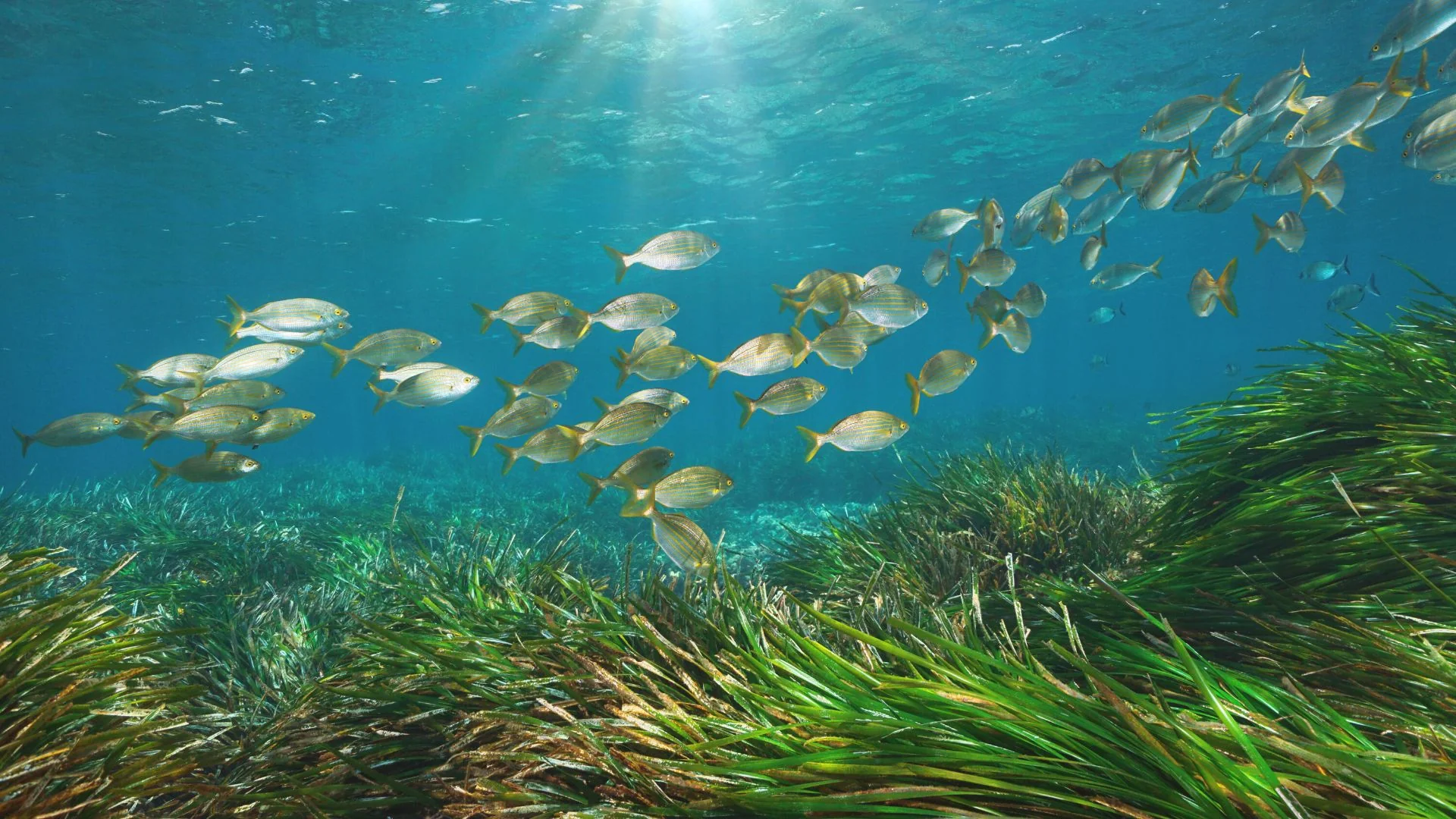
The light here is diffused, golden, filtering through the long, ribbon-like blades that sway in a slow, hypnotic ballet with the surge. You hover weightlessly, a visitor in a parallel landscape. To appreciate this place, you must recalibrate your expectations. This is not a crowded metropolis of marine life; it is a serene, sprawling countryside. The inhabitants are often small, camouflaged, and going about their business with a delicate purpose.
You must look closely. Peer into the dappled shadows at the base of the blades. A prawn, transparent as glass, might be meticulously cleaning its antennae. A small, well-disguised scorpionfish, the colour of mottled sand and leaf, lies in perfect ambush, its presence betrayed only by the vigilant, orbiting eye. Juvenile fish, in silvers and muted browns, use the dense foliage as a nursery, flitting between the stems in miniature schools. The possibility of a more unique encounter exists—a cautious octopus using the root mat as a den, or the rare, long-snouted seahorse anchored with its prehensile tail—but these are gifts, not guarantees. The ecosystem does not perform on demand. Patience is not just a virtue here; it is the entry fee.
This patience, however, rewards you with a deeper understanding. You begin to see the architecture. The seagrass blades are canvases for epiphytes: tiny algae, bryozoans, and hydroids that form a fuzzy, living crust, a micro-forest upon a forest. Tiny snails graze these miniature pastures. As you glide, you might disturb a camouflaged flounder, which erupts from the seabed in a cloud of sediment before settling again, vanishing instantly. The activity is constant, but it operates on a different scale and volume.
The true magnitude of this ecosystem, however, is invisible to the snorkeler. The Posidonia meadow is the lungs and the nursery of the Mediterranean. It produces oxygen—far more than a terrestrial forest of comparable size—and its complex three-dimensional structure buffers wave energy, protecting our cherished beaches from erosion. Its tangled root systems sequester carbon at a rate up to thirty-five times faster than tropical rainforests, locking it away in sediments for millennia. These quiet meadows are one of our planet’s most powerful allies against climate change. Floating on the surface, you are literally above one of the world’s most significant carbon sinks.
This realisation transforms the experience. You are no longer just looking for wildlife; you are bearing witness to a fundamental, life-giving process. Each blade of grass becomes a vital thread in a vast, living tapestry. The snorkel becomes a tool not for adventure, but for contemplation. The slow rhythm of your breathing synchronises with the gentle sway of the grass. In a world addicted to stimulus, this forced deceleration is a form of therapy. Your focus narrows to the minute: the pattern on a shell, the play of light on a single blade, the industrious journey of a hermit crab.
Of course, this fragile world faces profound threats. Anchor chains from careless boating scar the meadows, tearing out ancient rhizome mats that take centuries to recover. Runoff from agriculture and development clouds the waters, starving the Posidonia of the light it needs. Its decline is silent, unphotogenic, and catastrophic for the entire marine coastal system.